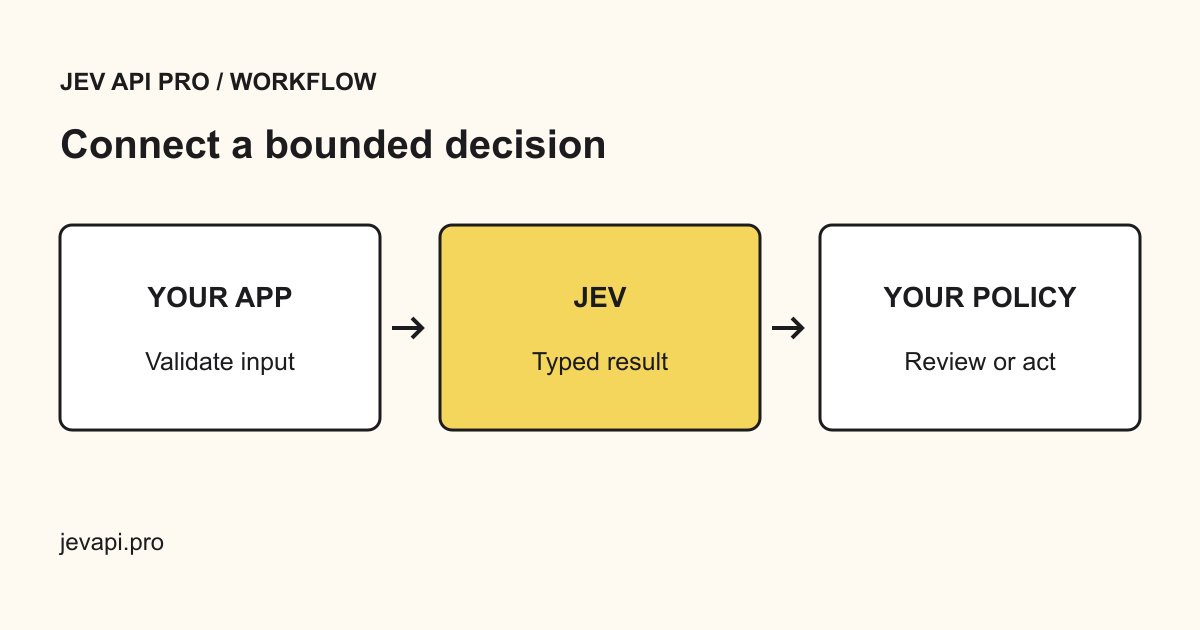
Choose one decision boundary
Pick the smallest question that changes what your application should do next. Tool guard reviews a proposed action; model route compares candidates you actually have; task route chooses a work path. Research review evaluates evidence already collected. Completion review compares work with acceptance criteria. None of these tools browse, execute another tool or run your tests.
The custom option accepts the same typed questions as the REST API. Keep exact calculations, eligibility checks and authorization in application code. A model judgment must never widen the permission the user already gave.
jev_guard_tool_call → allow | confirm | review | deny
jev_route_model → one supplied candidate id
jev_route_task → proceed_fast | deep_review | split_task | block
jev_check_research → accept | verify_more | reject
jev_review_completion → complete | verify_more | incomplete
jev_decide → your choice, noul or score questions
Inspect the input before running
The editor contains synthetic examples, not private account data. Replace them with short, relevant facts. Remove passwords, keys, payment details and unnecessary personal information. Missing facts stay missing; the model cannot inspect your computer or fetch hidden evidence.
Run sends your input to the live provider. The page uses your existing browser session and needs no API key. Anonymous access shares the playground limit of three attempts per source address per UTC day, subject to shared capacity. Signed-in decisions use your workspace credits; a successful new request uses one credit.
Read the answer before taking action
A typed choice is a recommendation within the labels you supplied. Check the review flag and the evidence behind the answer. High confidence is not a guarantee. The tool does not approve a refund, deploy code or confirm a claim just because it selected a favorable label.
If your policy requires a person, keep that check outside the model. When facts or scope change, run a new evaluation. When the connection fails without a confirmed result, retry the unchanged input with the same request identifier.
Connect after the small trial works
Use MCP for a compatible agent or REST for a server integration. Both use a workspace key created in your account with active paid API access. A TypeSafe, OpenRouter or another community site key is not a Jev API Pro key. This page does not collect any of those credentials.