Make the review queue actionable
Send a row to review when needsReview is true, required evidence is missing, or your policy requires a person even if confidence is high. Include your own source-record link, allowed outcomes, the rule revision and the request identifier. Do not send only a number to a reviewer and expect them to reconstruct the decision.
Assign one accountable queue owner and a maximum waiting time that fits the task. An overdue case must remain visible; it should not quietly become approved. A support-routing suggestion can wait for a team lead, while an account-security exception may need a different queue and stricter access.
if request_failed:
    keep_in_operational_recovery_queue()
elif result.needsReview or policy_requires_person:
    send_source_record_to_reviewer()
else:
    apply_only_the_already_authorized_reversible_step()
Close the loop without changing the evidence
Store the final human label, reason for disagreement and completion time alongside the model suggestion. Keep both values rather than overwriting the prediction. This lets you distinguish unclear rules, missing context, model errors and mistakes in the original reference labels.
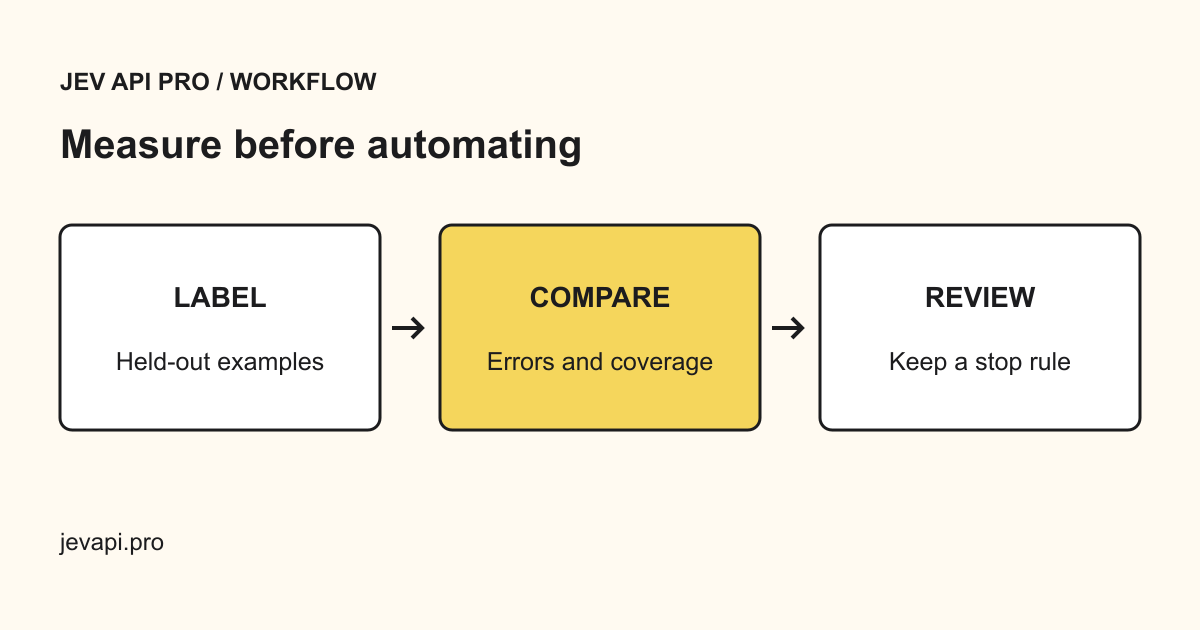
Use corrected examples to improve the next rule revision, but keep a fresh evaluation set for acceptance. Review backlog, high-confidence mistakes and turnaround time together. A smaller backlog is not a success if it comes from discarding difficult records.
Define the handoff
Return the proposed label, available confidence, request identifier, and review flag to your application. Attach your own source record and route the case to an existing queue. Jev API Pro does not replace your helpdesk or task system.
Keep failure separate from uncertainty
A valid answer with low confidence needs judgment. An unavailable provider needs a retry or operational fallback. Do not hide service errors inside an “other” category; it makes reliability problems look like customer data.
Learn from corrections
Record the reviewer’s final label in your own system. Review patterns in disagreements, clarify overlapping categories, and add representative cases to a held-out evaluation set. Human review should improve the rule, not just absorb an endlessly growing queue.