Support ticket classification with a review path
Turn an incoming customer message into one of the queues your team already uses. Keep the category list small, the routing rule explicit, and the final action under your control.
Read the guide ↗A Jev API workspace for support, sales, and operations. Define your labels, test a real message, and route uncertain results to a person.
3 anonymous attempts per day · 20 signup credits · No card for the trial
One label.
Confidence you can inspect.
A review path when it matters.
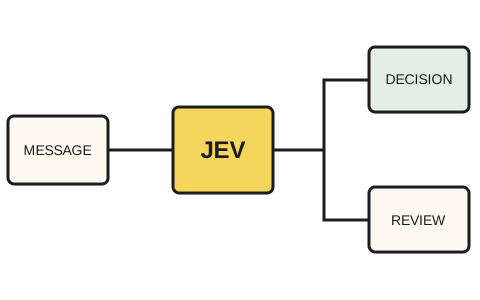
Illustrative sample — not a live model response.
Run a decision or open the labeled sample to see the result here.
A high score is not a guarantee. Keep a person in control of consequential actions.
API docs →Turn an incoming customer message into one of the queues your team already uses. Keep the category list small, the routing rule explicit, and the final action under your control.
Read the guide ↗A good qualification rule explains why a lead belongs in a queue. Evaluate the information a prospect actually provided against a short, written definition of fit.
Read the guide ↗Route a message to the next step without asking a chat model to write a paragraph. Supply the message, your allowed intents, and the rule that separates them.
Read the guide ↗Choose the outcomes your team actually uses.
See the label, confidence when available, and review flag.
Use the API when the result is ready for your process.
Explicit labels, visible failures, and idempotency keys. Your application stays in control of every action.
API docs ↗curl https://jevapi.pro/api/v1/decisions \
-H 'Authorization: Bearer YOUR_API_KEY' \
-H 'Content-Type: application/json' \
-H 'Idempotency-Key: ticket-123-v1' \
-d '{
"text": "I was charged twice this month.",
"instructions": "Choose the responsible team.",
"labels": ["billing", "technical", "account"],
"threshold": 0.85
}'Integration example. Replace YOUR_API_KEY with a key stored on your server.
No. Jev API Pro is an independent workspace. Jev is a model from TypeSafe, accessed here through OpenRouter.
Yes, when live decisions are available: up to three attempts per source address per UTC day, subject to shared trial capacity. A labeled example is also available.
We show an explicit error. Failed account decisions are refunded, and we do not substitute a different model silently.
Decision history stores the result, request hash, and operational metadata, not the submitted message. Your text is sent to OpenRouter and its model provider for inference.
One completed classification within the published input limits uses one credit. Signed-in accounts receive 20 signup credits and can claim two daily check-in credits.
Use the API to get decisions. Your own application checks permissions and performs actions. Low-confidence or missing-confidence results should go to review.
Answers come from the published product guide. For account-specific questions, contact support.
Contact