A faster browser agent
A small open-source browser agent that rebuilds the page action space at every step and asks for the next action from it.
A categorised index of community submissions: agents, developer tools, interfaces, games and experiments. Each entry is one line about what it does and a link to the maker’s own post. This is an independent workspace, not the vendor.
Agents that ask for one bounded decision per step instead of generating the next action as text.
A small open-source browser agent that rebuilds the page action space at every step and asks for the next action from it.
Drives a cloud browser session over CDP, choosing each action from the current page and keeping a step-by-step replay.
Pairs computer-use control with a decision call per action, to see how much of a desktop loop a small model can carry.
Build-time and run-time helpers: routing, compaction, generated interfaces and command-line decisions.
Scores past tool calls to decide which ones to drop, instead of summarising the whole transcript with a language model.
A command-line tool an agent harness can call for yes-or-no questions, choosing between options, or scoring against criteria.
Renders your own components and actions from a decision-shaped response, so an interface can be chosen rather than written.
Classifies a prompt as simple or hard while the user is still typing, so a fast mode can be offered before the request is sent.
Everyday software that reads intent: forms, spreadsheets, inboxes, notifications and input methods.
An ambient input experiment: the keyboard itself asks what the next suggestion should be, at the edge of generative interfaces.
A form that decides which question to ask next instead of encoding the branching as nested conditions.
Type a column heading such as urgency and each row is rated against it as you work, within the time a keystroke allows.
Applies formatting to a spreadsheet by judging what each cell means, rather than by matching rules a user wrote in advance.
Searches mail by what the message was about, which works on the small result set a keyword or semantic search has already narrowed.
Classifies incoming app notifications and messages as promotional or not, and mutes the promotional ones without deleting them.
Runs a multi-criteria score across thousands of products in one batch, the shape most catalog and list work takes.
Classification, ranking and retrieval over documents, feeds and search results.
Reads a 26-sheet construction plan set into a bill of materials, replacing a slower model step in an existing pipeline.
Sliders for technical depth, drama and practicality re-rank a shared feed for one reader, instead of one order for everyone.
An open-source search front end that chooses where to look and how to rank the results for a plain-language question.
Media, motion and capture: try-on, model routing for generation, screen flows and animated characters.
Reads a spoken transcript and what the person is wearing, picks an item from their wardrobe, and changes the outfit live.
A browser agent captures a fresh product flow for whatever interface pattern you ask for, rather than browsing a static library.
Reads a generation prompt and picks which video and image models on the platform should handle it.
Composes a 3D character’s expression from ten decisions per message — mouth, brows, eyes, cheeks, gaze and body — with no preset expressions.
Games where a per-turn decision is cheap enough to make every turn, including experimental ones that did not work out.
Picks every move; on each death the sandboxed game state is forked into several timelines and the surviving run becomes the new canon.
Runs several futures in parallel from one checkpoint, then continues the game from the outcome a reviewing model rates best.
A word game where a per-turn model call is affordable enough to run as part of ordinary play.
Several copies negotiate a board game against each other; the honest finding is that they stop trading and stall.
Splits a game across three models: one designs the world, one chooses each action, and one turns a decision into video.
Open-ended attempts that show what a decision-shaped model can be pointed at.
A hundred on-screen characters each decide whether they are bored of you, so the audience reacts without a scripted animation.
A public toy that makes the point of the model: it will not answer your question, it will judge it.
An explicitly experimental account where the model decided the trades; published as an experiment, not as a strategy.
Reads dozens of structured trading signals at once and returns a decision, leaving execution of the trade to the surrounding system.
A drawing experiment that predicts pixels in parallel rather than generating an image token by token.
Extension work that has to classify fast enough to run while a page is being read.
Classifies page elements as advertising or not and removes the ones that are, instead of matching a list of known networks.
Target selection and control in simulated environments, where the decision is one step of a larger loop.
Chooses which object to collect from a spoken instruction, while a separate system handles the motion in simulation.
Research and rule-following experiments, published as experiments rather than as advice.
Filters a news stream down to the companies worth a closer look, as a research step rather than an order.
Every entry comes from a public submission by its maker and links to that submission, so you can read the original instead of trusting our summary. We group the entries by the category the maker filed them under and write one line describing what the project does. We do not re-host their code, their video or their text, and this page is not an endorsement of any of them.
An index is a reading list, not a benchmark. Nothing here was measured by this workspace, and a project that appears to work in a demo may not survive production traffic, a provider change or a terms-of-service review. Treat each entry as an idea and a starting point, then check the maker’s own repository or demo before relying on it.
Some screenshots quote a cost per decision or a latency. Those are the maker’s measurements from their own setup: their model route, their input length, their hardware and their network. A number like that does not transfer to your traffic, and we deliberately do not repeat the figures as if they were ours.
What this workspace charges is documented instead: one credit per completed decision, with the limits on the rate-limits page and the request contract in the API docs. If you need to compare providers on price, do it against your own inputs rather than against a screenshot.
Four shapes come up again and again. First, a decision per step inside a loop: an agent asks what to do next from the actions a page actually offers. Second, a decision per row at volume: scoring or labelling thousands of rows in a batch, where one wrong label is cheap and a slow pipeline is not. Third, a decision that picks a branch in an interface: a form choosing its next question, a spreadsheet rating a row, an inbox searching by intent. Fourth, a decision that routes: picking a model, a queue, or a next work path from candidates that already exist.
The shared trait is that the question is bounded and the answer domain is written by the caller. None of the interesting entries generate prose; they choose among options the surrounding system then acts on.
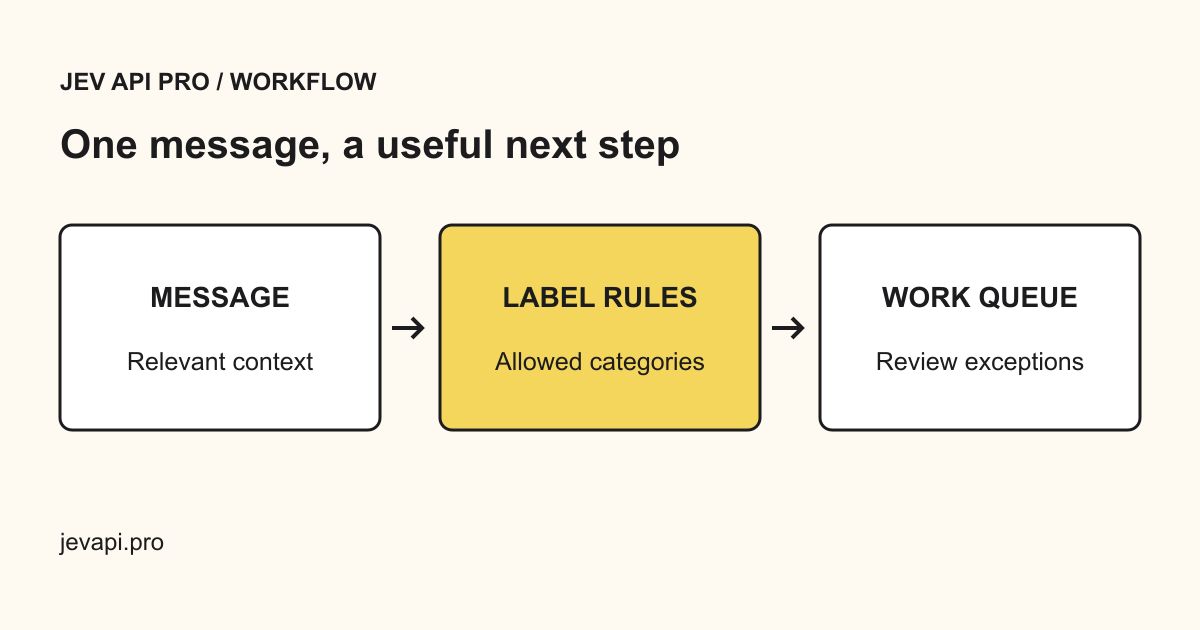
Start with the trial on this site: paste a representative message, set the labels your process already uses, and look at the result and the review flag. If the answer is good enough for the smallest useful step, connect it through MCP for an agent or REST for a server, with a key from your own workspace.
Keep the authorization, the irreversible actions and the acceptance tests outside the model. A showcase is an idea for where a decision goes in a workflow; the permission to act on it stays with your application and its user.
Try a bounded judgment before connecting an agent. This independent workspace uses Jev through OpenRouter. Your main model still plans the work; your application controls permissions and actions.
Read the guide ↗An additional judgment step for an agent that already has its own model and tools. This is the Jev API Pro workspace endpoint, not TypeSafe or another community server.
Read the guide ↗A Skill explains when to ask a decision tool and how to interpret its result. MCP carries the request. Downloading an instruction file does not connect an agent or spend inference credits.
Read the guide ↗Send one piece of text, the rule that separates the outcomes, and the labels your process already uses. The endpoint returns the chosen label, its probabilities when the model provides them, and a review flag.
Read the guide ↗Answers come from the published product guide. For account-specific questions, contact support.
Contact