Identify the provider and the product you need
The official TypeSafe website and documentation describe Jev through their System One approach. Its job is to turn supplied state and bounded questions into typed answers. If you are looking for the official model documentation, account console, or direct API terms, use those official destinations. This workspace adds its own classification interface and workflow; it does not own the underlying model.
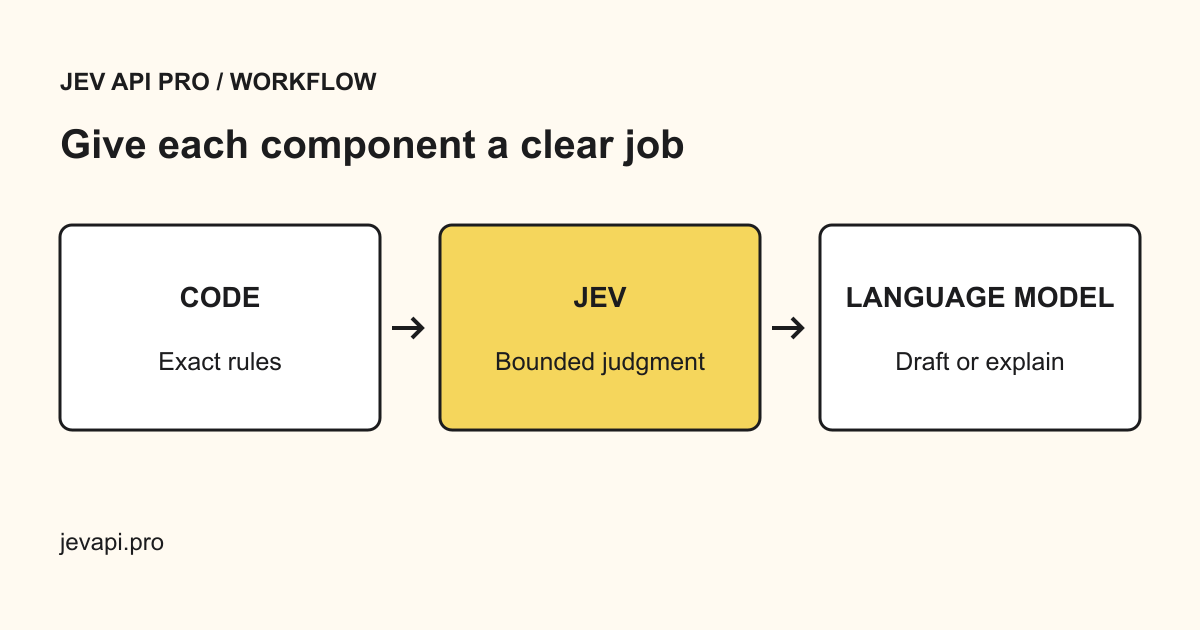
Start with the user's job rather than the product name. A developer integrating an existing service may want a model endpoint. A team checking category definitions may prefer a visible playground and review workflow. A request to generate a long explanation is a different job. Compare the relevant interface and support responsibility, not just whether a page mentions Jev.
Official TypeSafe website · Official TypeSafe documentation · What Jev does
Separate direct access, a gateway, and a workspace
The official quickstart uses a TypeSafe account and a direct System One endpoint. OpenRouter is a separate access route. Jev API Pro exposes a workspace classification contract and uses OpenRouter on the server. These layers can use different credentials, model identifiers, payloads, quotas, and error responses. Do not move an example between services by changing only the hostname.
For example, an official request describes state and typed questions, while this site's classification request uses its documented text, instructions, labels, and review threshold. Decide which contract your application needs before creating a key. Keep secrets in a server-side credential store and copy only public examples into source control. If a request fails, first confirm its endpoint and credential issuer instead of repeatedly retrying an incompatible payload.
TypeSafe direct API quickstart · Jev API Pro integration guide · Workspace authentication
Read prices with the billing unit attached
On 25 September 2026, TypeSafe's model page listed Jev 1.13 at US$0.042 per million input tokens with output tokens free. This is a dated reference to the direct provider listing, not a quote for this workspace or a guarantee of future pricing. Recheck the source before estimating a purchase, and confirm whether your chosen gateway applies the same terms.
Jev API Pro publishes its own plans and workspace credits. A credit is not an input token, and a workspace subscription is not the same purchase as a TypeSafe account. To compare options, estimate representative input volume, request failures, extra model calls, and human review time. Then compare the total service cost for correctly completed work, including whichever workflow features your team actually uses.
TypeSafe model and price listing · Jev API Pro plans and credit rules
Keep Laya's ownership and comparisons clear
Laya's public model repository is published under ConvaiInnovations and links to its own source repository. It should not be presented as a second TypeSafe model. The projects can be discussed as different approaches to bounded decisions, but sharing a use case does not make their publishers, licenses, deployment options, or API contracts the same.
A useful comparison starts with your constraints: whether you need hosted or local operation, what data you can send, and who will operate the service. Then test both approaches on the same reserved examples. Do not compare local inference timing with a hosted request as if they measured the same boundary. Published or community benchmarks can suggest tests, but they do not establish speed, accuracy, or cost for your particular workload.
Laya's publisher and model card · Laya's linked source repository
Check the operating contract, not only the demo
Before integrating any route, identify its current model, input limits, supported languages, rate limits, retention terms, and retry behavior. Do not assume that a workspace inherits every provider feature or that a provider's policy applies unchanged to a gateway. Keep a record of the exact service and documentation you reviewed so future changes have a clear reference point.
Test unavailable service, invalid credentials, invalid input, malformed response, and uncertain decision as different cases. Bound retries and use the idempotency contract provided by the endpoint. The application should retain the request status and a useful error identifier without logging secrets. A successful demo verifies one request; it does not prove reliable handling of the rest of your operating conditions.
Workspace rate limits and errors · Workspace request contract
Run a small trial before choosing a plan
Take a representative set of inputs and label the expected outcomes before testing. Include ordinary messages, conflicting requests, unfamiliar wording, and examples that need a person. Compare the suggested result with the expected one and count failures as well as successes. If multilingual input matters, test each relevant language separately instead of assuming that translated instructions produce equivalent quality.
The decision to adopt a service should follow that evidence. Choose direct access when you need its documented model interface, or evaluate this independent workspace when its classification and review flow match your task. Keep the provider, gateway, and workspace identities visible to your team. You can start with the API guide, inspect a result, and review plan details once the workflow proves useful.
Start with the Jev API guide · Plan a fair evaluation · Explore the playground