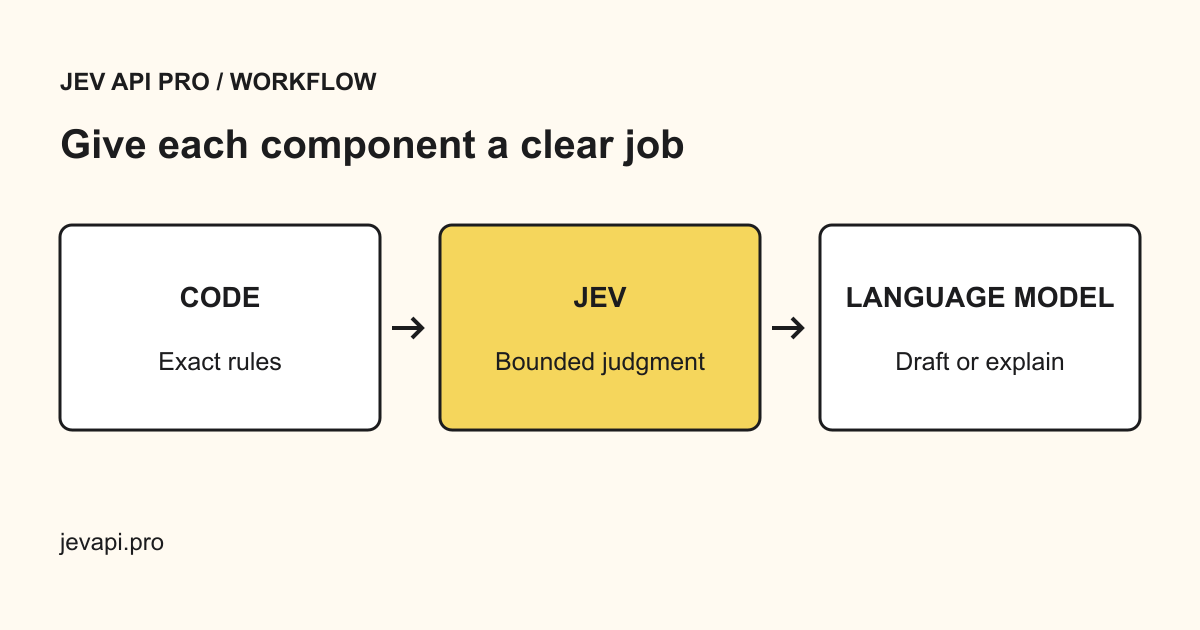
A decision inside a larger workflow
A chat model can draft a reply or explain an idea. A decision model answers a bounded question such as which queue should receive a ticket. Your application defines the available outcomes and decides what to do with the answer.
Upstream Jev accepts three question types: choice (one label from the criteria you write), noul (a yes/no probability with true and false criteria), and score (a position on an ordered rubric). This workspace sends either a single choice question over 2–12 labels, or up to four typed questions in one request. The batch workspace can also generate a draft rule set from a short prompt, which you edit before anything runs.
OpenRouter: TypeSafe SDK and Jev · OpenRouter Jev tutorial · Request contract on this site
Structured does not mean infallible
Returning an allowed label prevents an unexpected output format. It does not prove that the chosen label is correct, and a high reported probability is the model’s own output rather than a measured accuracy for your data. Evaluate your own examples, keep an uncertainty path, and retain ordinary authorization checks around actions.
Known limits of Jev 1.13
TypeSafe’s version-specific limitations, reviewed by the provider on September 17, 2026, include unreliable counting, arithmetic and date comparisons. Keep those operations in code. Remove irrelevant context, align instructions with criteria, and test negation and indirect references on your own examples.
Adversarial text can influence the answer. A classifier must not be the only authorization or safety control. Separate questions also need not obey probability identities: do not assume a question and its negation sum to one, or transfer a threshold from noul to choice.
TypeSafe reports its strongest performance in English. A translated interface does not establish equal model accuracy in that language; evaluate each language and rule version separately.
TypeSafe: Jev 1.13 known limitations · TypeSafe: model and language notes
Our role
Jev API Pro is an independent workspace that calls Jev through OpenRouter. It is not TypeSafe and not the official Jev provider. Model availability and behavior depend on the upstream service; this deployment requests typesafe/jev-1.13.
Direct provider access may fit if you only need inference and already operate your own workflow. This service adds a batch workspace, review flags, result history, account API keys and prepaid credits. It does not claim exclusive model access or the lowest raw inference price. A Jev API Pro key is for this site’s /api/v1/decisions endpoint, not an OpenRouter or TypeSafe credential.