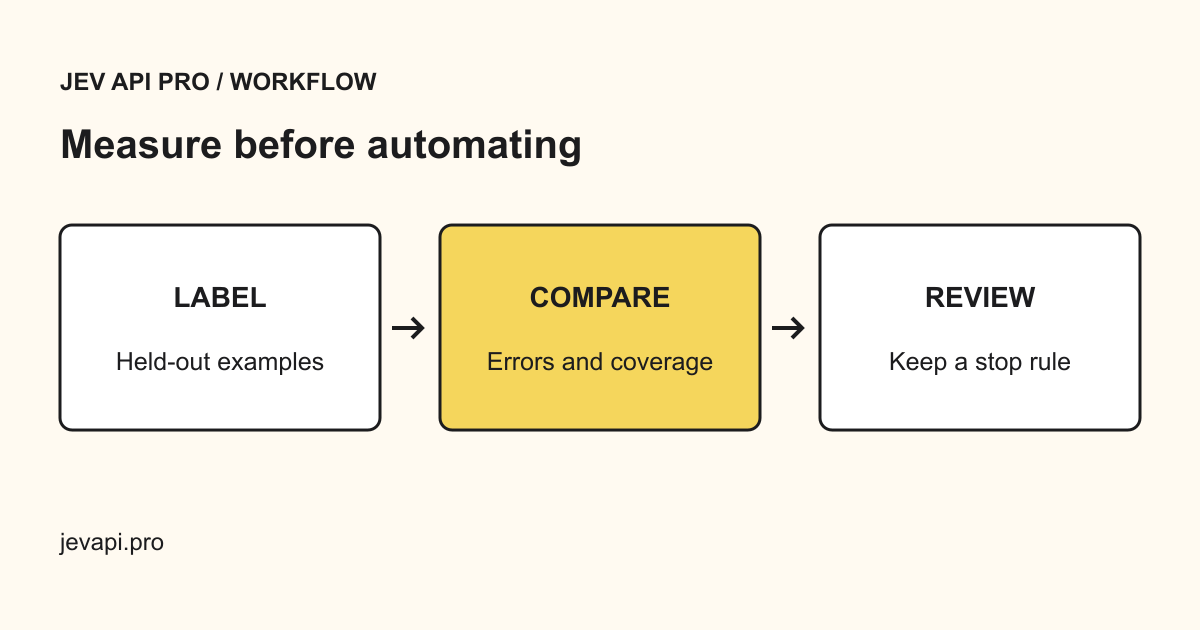
Work through one evaluation before choosing a threshold
This is an illustrative calculation, not a measured Jev benchmark. Suppose a held-out set contains 100 messages. At one threshold, 80 are accepted automatically: 78 match the reference and two are wrong. The other 20 go to review. Automation coverage is 80%, and accuracy among automatically accepted results is 78 / 80 = 97.5%. Neither number tells you whether the two mistakes caused serious harm.
Break those errors down by label and consequence. An incorrect product tag and a mistakenly approved refund do not have the same cost. Keep exact permissions outside the classifier, then compare thresholds using the same examples and the same model version. Do not select a threshold on the final held-out set and call that an independent result.
Illustrative only
held_out = 100
automated_correct = 78
automated_wrong = 2
review = 20
coverage = (78 + 2) / 100 = 80%
automated_accuracy = 78 / 80 = 97.5%
Keep a reproducible evaluation record
Keep the source row identifier in your own system, along with the human label, rule revision, requested model, returned model, threshold, request ID and outcome. Record end-to-end latency and confirmed failures separately. A provider name alone is insufficient if the underlying model changes.
Start with shadow routing, where suggestions cannot change a customer record. Name an owner who can disable automation and specify a stop rule before rollout. Recheck after changed labels, a new model version or a shift in message language; a translated interface is not evidence of equivalent model quality.
Keep a held-out set
Write down the labels and their definitions. Have a knowledgeable person label representative records. Resolve disagreements before treating those labels as the reference. Keep a separate set that you do not use to tune instructions.
Count the errors that matter
Overall accuracy can hide failure in a small, important category. Count errors for each label, review ambiguous cases, and measure how much work remains manual at the chosen threshold. Include language and channel differences present in your real traffic.
Roll out in stages
Start in suggestion mode. Compare model decisions with existing outcomes, then automate only a reversible step. Set a clear stop condition if failure rate or review volume rises. Save the request identifiers and model name with evaluation results so future comparisons are meaningful.