Treat the name as a product concept
TypeSafe uses the System One label for fast, structured judgments and relates the name to the distinction between intuitive and deliberative thought. That analogy describes its product approach. It does not establish that a model thinks like a person, and it does not replace an evaluation on your own task. When documenting an integration, name the provider, model version, and output contract instead of relying on the analogy.
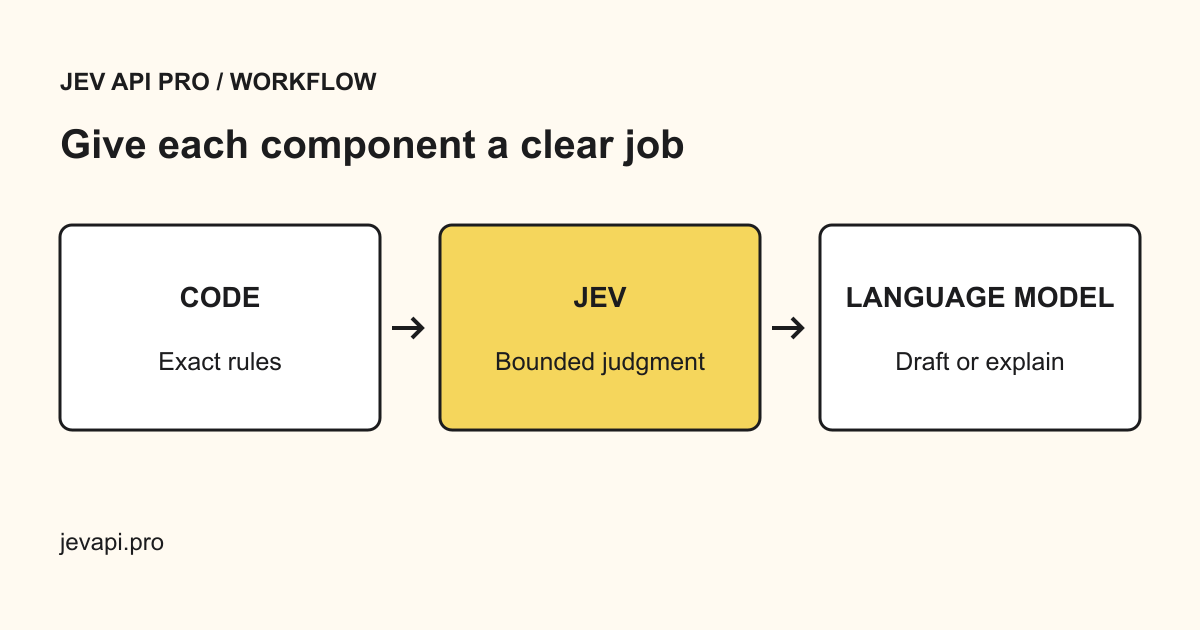
The practical distinction is the request shape: provide a state and ask bounded questions about it. Your application receives typed values that it can validate and use. The model does not become the application's planner, browser, tool executor, or source of permission. Those responsibilities remain explicit parts of the surrounding system.
Match the question to the answer type
Choice selects from options you supply. Score evaluates a question on a defined scale. Noul represents a proposition with a value between zero and one. These are provider primitives, not three promises that every downstream workspace exposes the same fields. Read the contract for the endpoint you call. This site's classification API has its own request and response shape.
For an incoming ticket, a Choice question could ask which team owns the first response. A separate question might assess whether the message contains enough information to route it. Do not bury ownership, urgency, sentiment, and authorization inside one vague question. Splitting genuinely different decisions makes mistakes easier to identify; it does not automatically make them independent or correct.
Documented Jev question types · This workspace's API contract
Compose the workflow in ordinary code
Imagine a message saying that an invoice has two charges. Supply the relevant product context and the allowed destinations, such as Billing, Support, and Access. The decision suggests a destination. Your code then checks that the response is valid, decides whether review is required, and records the suggestion. Issuing a refund is a separate operation with separate evidence and permissions.
If one question depends on an earlier answer, express that dependency in your application. Do not assume that multiple questions in a request form a hidden chain of reasoning. Keep arithmetic, account ownership checks, and transaction rules outside the language judgment. This produces a small, inspectable handoff rather than asking a model to control an entire business process.
Design an explicit uncertainty path
Keep three outcomes distinct: a valid decision you accept, a valid decision that needs review, and a request that failed. A timeout is not a low-confidence answer. A missing field is not permission to choose the first option. Your interface and logs should let an operator tell these situations apart without exposing sensitive input or credentials.
Use a labeled sample to decide which results can be accepted automatically. Record both review volume and mistakes among accepted results. A high confidence value may still accompany the wrong answer, especially when your data differs from the examples used to choose a threshold. If an action has a high cost or cannot be undone, permission checks remain mandatory regardless of model confidence.
Define a human review path · Evaluate decisions before automation
Check the limits against your actual inputs
The Jev 1.13 limitations published by TypeSafe include weaknesses with precise numerical reasoning, some negations, ambiguous instructions, and irrelevant or adversarial context. Avoid turning these known weaknesses into hidden dependencies. For example, calculate an invoice total in code and ask a narrowly framed classification question about the message, rather than asking the model to audit the arithmetic and authorize repayment together.
Test the languages, terminology, message lengths, and mixed topics your users actually submit. Start with the smallest context that preserves the decision's meaning. A longer input can contain more distraction as well as more evidence. Keep a versioned test set and rerun it when changing the model or instructions; a stable response format does not mean the behavior is unchanged.
Choose an access route before budgeting
You can study the official TypeSafe quickstart for direct model access, or use this independent workspace's classification flow. They are different services. A provider API key, gateway key, and workspace credential are not interchangeable. Follow the documentation for the chosen hostname and endpoint, store secrets on your server, and inspect one real response before wiring it into a larger process.
Model and pricing references were checked on 25 September 2026. Check the current provider rates and the workspace's own plans separately; token billing and workspace credits measure different things. The smallest useful trial is a representative sample with expected labels, visible review outcomes, and a record of request failures. That tells you more about fit than the System One name alone.
Official TypeSafe quickstart · Try the Jev API workspace contract · Workspace pricing