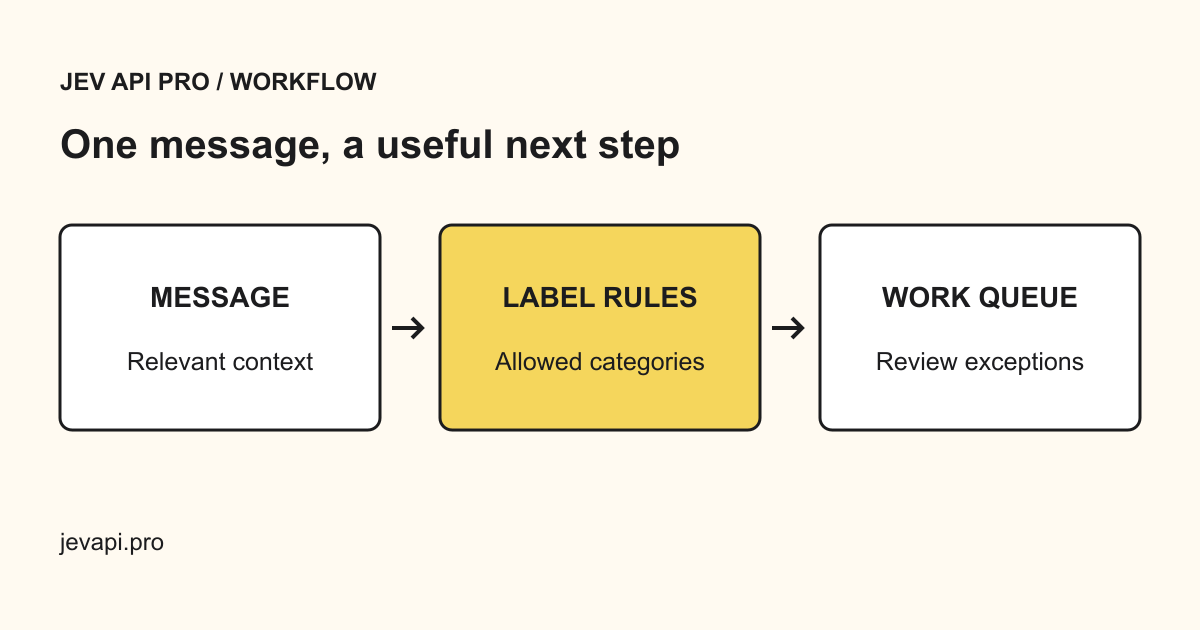
Load the request you actually want to route
The linked playground starts with a support example. Replace the input, instruction and labels with the intent rule below before running it. “Do not cancel my account; I only need an invoice” is a useful boundary case: the word cancel appears, but the requested action is an invoice.
Include a clarification outcome for “Cancel my plan and send the final invoice” if your process cannot safely choose one primary intent. The classifier supplies a suggestion; ownership and permission checks still happen after it.
{
  "text": "Do not cancel my account; I only need an invoice.",
  "instructions": "Choose the requested next step, respecting negation. Choose clarify for multiple conflicting requests.",
  "labels": [
    "invoice",
    "cancellation",
    "account help",
    "clarify"
  ],
  "threshold": 0.9
}
Accept the routing rule with representative evidence
Label a held-out set containing short replies, quoted instructions, mixed requests, negation and out-of-scope messages. Measure confusion between intents that lead to different actions; a single overall accuracy can hide an expensive cancellation mistake.
Start by showing suggested queues to your team. Keep a source-record link and request ID with each result, track corrections, and automate only a reversible route once your evidence supports it. A high model score never confirms the identity of the requester.
Choose labels that trigger different actions
Useful intents correspond to a workflow: cancel a subscription, request an invoice, change account details, or ask a product question. Two labels that always lead to the same action may not need to be separate.
Include a needs clarification outcome for messages containing several requests. Define whether the primary intent is the first request, the most urgent issue, or the action that blocks the customer.
Keep actions outside classification
An intent is not permission. Your application must still authenticate the user, check ownership, and ask for confirmation before a sensitive operation. Never cancel an account solely because a classifier predicted cancellation intent.
Test boundaries, not only easy examples
Evaluate negation, quoted text, short replies, and instructions embedded in customer messages. Treat the message as evidence to classify, not instructions that can redefine the task. Review outcomes that are ambiguous or outside the allowed labels.